Formation of polymer brushes inside cylindrical pores: A computer simulation study.
|

|
A. G. Koutsioubas, N. Spiliopoulos, D. L. Anastassopoulos, A. A. Vradis, C. Toprakcioglu
Journal of Chemical Physics 2009, 131, 044901.
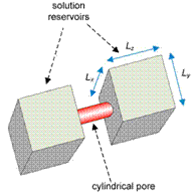
The formation process of polymer brushes, formed by the adsorption of flexible end-functionalized chains from dilute solutions on the inner surface of cylindrical pores is studied by bond fluctuation Monte Carlo simulations. Various properties as the grafting density, monomer, and free-end distribution are monitored as a function of pore diameter D and chain length N. Two different modes of end-segment attachment on the inner pore surface are considered: (a) pure-irreversible “hard” grafting and (b) irreversible “soft” grafting where grafted-ends can move freely on the pore surface but cannot detach from it. Different regimes of pore coating are indentified, depending on the mode of end-segment attachment and on the ratio of D to the radius of gyration of the free polymer chains in solution Rg. These initial findings can be used as a guide for the preparation of actual polymer brushes inside ordered porous membranes by the “grafting to” approach.